
Spain Non-Lucrative Visa (NLV) Health Insurance Requirements (2026 Guide)
Spain's Non-Lucrative Visa needs more than "private health insurance." Here is what a compliant 2026 policy should contain, the Spanish wording consulates look for, and the plans that are most often refused.
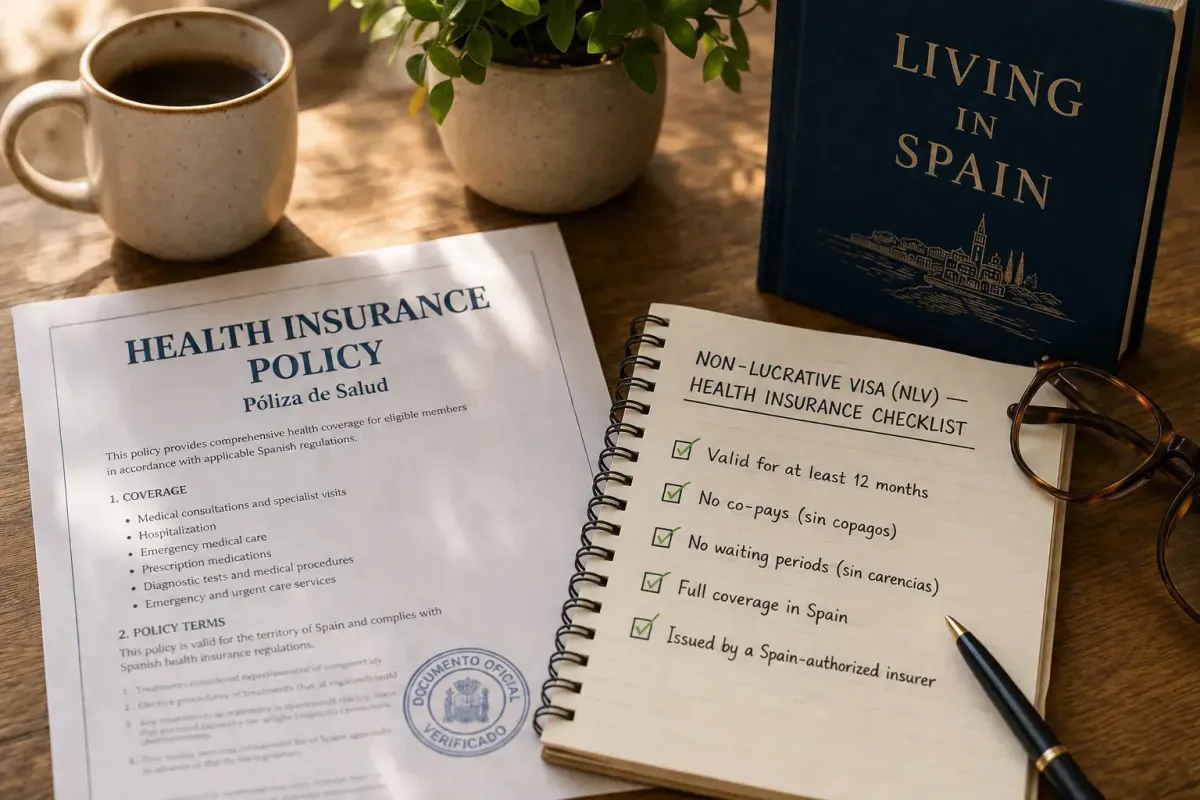
If you're applying for Spain's Non-Lucrative Visa (NLV) in 2026, your health insurance policy can determine whether your application moves forward or is delayed. Spanish consulates don't just require "private health insurance." They expect a policy that meets specific legal standards: no co-pays (sin copagos), no waiting periods (sin carencias), full coverage in Spain, and continuous protection for at least 12 months. Many applicants mistakenly purchase travel insurance or international expat plans that seem comprehensive but fail to meet Spain's immigration requirements. This guide explains exactly what the Spanish authorities expect, how to avoid the most common and costly mistakes, and how to choose a policy that gives your visa application the best chance of approval.
Editor's note: these requirements are set nationally, but individual consulates can request additional documentation even when a policy is compliant. The figures below reflect 2026 practice; confirm the current detail with your carrier before you submit.
What the NLV health insurance requirement is in 2026
Health insurance is one of the two pillars of a Non-Lucrative Visa application, alongside the income threshold. The requirement applies to each person on the application: a couple needs two policies or one that names both, and any children on the visa need coverage too. For how insurance fits alongside the money side of these Spain residency visa requirements, read the Non-Lucrative Visa Spain 2026: The Complete Guide for Retirees and Non-Workers, and for the financial side, How Much Income Do You Need for the NLV in 2026?.
Underneath the paperwork, a consular officer is really checking one question.
Can this applicant access healthcare in Spain without relying on the public healthcare system?
Every condition below is a way of answering yes.
The five things a compliant NLV policy should have
Spain does not publish a single tidy checklist, but consulates have converged on the same five conditions. A policy that misses one of them risks a delay or refusal.
- Issued by an insurer authorized to operate in Spain. The carrier should be licensed by the Dirección General de Seguros y Fondos de Pensiones (DGSFP), the Spanish insurance regulator. A plan sold only in your home country, however good, does not clear this bar on its own.
- No co-payments (sin copagos). You should not be charged a fee each time you see a doctor or use a service. Many domestic plans are cheaper precisely because they include co-pays, and those cheaper versions are the ones that tend to fall short for a visa.
- No waiting periods (sin carencias). Coverage should start in full from day one. Policies that make you wait months before surgery, maternity, or specialist care usually fail, because a gap in coverage is a gap the state might have to fill.
- Coverage equivalent to Spain's public healthcare system, without significant benefit limits. The policy should broadly match what Spanish public healthcare provides. Hospitalization, surgery, specialist and outpatient care, and emergency treatment should all be included. Bear in mind that pre-existing conditions can affect pricing and, with some carriers, what a policy covers, so declare them and read the conditions.
- Continuous coverage for the initial residence period, typically demonstrated with a 12-month policy. The visa covers your first year, so the coverage should span the same window without a renewal gap. Some consulates want to see that first year paid in advance.
When renewing your residence permit, you'll generally need to show that compliant health insurance remains in force.
The wording consulates look for: sin copagos and sin carencias
Here is the detail that trips up otherwise careful applicants. Many consulates first look for clear confirmation that the policy is sin copagos and sin carencias. If the certificate is unclear on either point, additional documentation may be requested, which is where delays creep in.
This is why a policy from a Spanish carrier, issued in Spanish with the compliance wording printed on the certificate, tends to move faster than a broader international plan. Ask your insurer for a certificate (certificado) specifically for a residence visa, not the generic welcome letter. A carrier that handles the NLV regularly will produce a certificate stating that the policy has no co-payments, no waiting periods, full territorial coverage in Spain, and a twelve-month term.
Policies that are commonly refused
Some products look comprehensive but fall short. Travel and Schengen short-stay policies are among the most common reasons for refusal: they cap payouts, exclude pre-existing conditions, and expire, none of which suits residence. International or expat "global" plans often carry co-pays or deductibles in the pricing, which can make them non-compliant even when the headline coverage looks generous.
Language itself is not the problem. A policy in English can still qualify if the carrier is authorized in Spain and the certificate clearly confirms the compliant terms. A Spanish policy issued in Spanish is simply less likely to trigger a request for more information, because the wording the reviewer wants is already there.
Why Spain's public system doesn't cover you at this stage
Applicants sometimes ask whether they can lean on Spain's public system instead of buying private coverage. In most cases, new NLV applicants cannot rely on Spain's public healthcare system to satisfy the visa requirement. Public access generally follows from paying social security, or from a special pay-in scheme called the convenio especial that some regions open to residents after a period of registration, and neither is typically available at the point you apply. If you would be working remotely rather than living off savings or a pension, the Spain Digital Nomad Visa vs Non-Lucrative Visa: Which Is Right for You? comparison covers that different route.
Which insurers are authorized to cover you in Spain
Several carriers are licensed by the DGSFP and sell policies written for residence visas. Names commonly used for the NLV in 2026 include Sanitas, Adeslas, DKV, ASISA, Mapfre, Caser, ASSSA, and Cigna Spain. Any DGSFP-authorized insurer that will issue a sin copagos, sin carencias certificate can work.
Always verify that the insurer is currently authorized by the DGSFP, as the market changes over time. Whichever you choose, what matters is that the certificate carries the compliant wording for your visa, not the logo on the policy.
What health insurance for the NLV costs in 2026
Price tracks mainly with age. A visa-compliant policy commonly runs about €45 to €85 a month for applicants under 65, and roughly €120 to €250 or more a month for applicants over 65, climbing steeply past 75. Treat those as broad 2026 ranges, not fixed rates: premiums vary by age, province, insurer, and the answers on your medical questionnaire (underwriting). A couple should budget for two policies unless one plan names both.
Age cutoffs matter too. Some carriers stop taking new customers around 65 while others accept applicants into their early seventies, so it pays to arrange coverage before a birthday closes a door. Get an actual quote for your age and situation, including any pre-existing conditions, before you build it into your budget, and remember some consulates want the first twelve months paid up front, so plan for the lump sum rather than the monthly figure.
Common NLV insurance mistakes to avoid
Buying travel or Schengen insurance. These are among the most frequent rejections, because they look like health coverage but are built for trips. If the policy has an expiry tied to a journey or a cap on total payouts, it is unlikely to pass.
Choosing a plan with co-pays to save money. The cheaper tiers of Spanish private medical insurance usually include copagos. The saving is real, and so is the risk of refusal. For a visa policy, pay for the no co-pay version.
Submitting a policy with waiting periods. A plan that delays surgery or specialist care for the first few months carries waiting periods (carencias), and a consulate reading the certificate may flag the gap. Confirm the wording says sin carencias before you submit.
Assuming a broad international plan is enough. Even when the coverage is wide, if the carrier is not authorized in Spain or the certificate does not clearly confirm the compliant terms, the reviewer may be unable to verify it. A certificate that states the terms plainly removes the doubt.
Leaving the certificate to the last minute. Insurers issue a generic welcome document by default. The visa-specific certificate (certificado) with the exact wording can take a few days to produce, so request it early rather than chasing it in the week before your appointment.
Practical tips for NLV health insurance in 2026
Buy the policy from a carrier that handles residence-visa coverage regularly, and ask for the visa-specific certificate in writing at the same time. Getting the compliant document is a separate step from paying the premium, and the two do not always arrive together. Line the insurance up in parallel with your financial paperwork rather than after it, because the certificate, and any correction to its wording, adds days you will want in hand.
Above all, read the certificate before your consulate appointment and confirm it states, in plain terms, no co-payments, no waiting periods, full coverage in Spain, and a twelve-month term. A compliant policy can still prompt a request for extra documentation, so bring your full policy conditions as well as the certificate.
Where Spain's NLV health insurance rules come from
The insurance condition sits in Spain's immigration framework, the Reglamento de Extranjería, and is applied through Spain's consular network. You can read the current official requirement on the Ministry of Inclusion's page for initial non-lucrative residence authorization, see how a single consulate spells out the 12-month, no-copay, no-waiting-period wording on the Los Angeles consulate's NLV page, check whether a carrier is licensed through the DGSFP register, and find the consolidated immigration regulations in the official gazette at boe.es. Requirements evolve, so treat those sources as the final word over any guide, including this one.
FAQ: health insurance for Spain's Non-Lucrative Visa in 2026
Does travel insurance count for the NLV?
Generally no. Travel and Schengen policies are usually refused for long-stay Spanish visas because they are built for trips, cap payouts, and expire. You need a resident health policy with full coverage, no co-pays, and no waiting periods.
What does sin copagos actually mean on my policy?
It means you pay nothing at the point of care: no fee per doctor visit, test, or treatment. Consulates look for this because co-payment plans usually do not meet the requirement. Ask your insurer to confirm it appears on the certificate.
Can I use an international or US health plan?
Sometimes, if the insurer is authorized to operate in Spain by the DGSFP and the policy meets the no co-pay, no waiting period, twelve-month standard. Many global plans fall short on the co-pay or the authorization point, so a Spanish-issued policy is often the simpler route. If you are moving for remote work, the Spain Digital Nomad Visa 2026: Complete Guide for Remote Workers sets out that visa's own rules.
How much should I budget for Spain Non-Lucrative Visa insurance?
Roughly €45 to €85 a month under 65, and about €120 to €250 or more over 65, per person, though premiums vary by age, province, insurer, and underwriting. Some consulates want the first year paid in advance, so plan for the annual cost.
Do both members of a couple need coverage?
Yes. Each person on the application needs a compliant policy, whether that is two separate policies or one plan that names both applicants and any dependent children.
When does the policy need to start?
Coverage should be in force with no waiting period, so arrange it to run from the point your residence begins. Bring the certificate showing the start date and the twelve-month term to your appointment.
Can I cancel my insurance after my visa is approved?
No. You are expected to maintain compliant health insurance throughout the period for which it is required under your residence status, and it is checked again when you renew.
Moving to Spain on an NLV or Digital Nomad Visa? Stop guessing.
Most NLV and DNV applicants spend weeks piecing together their application from consulate websites, outdated blog posts, and contradictory Facebook threads, only to wonder if they've missed something.
VidaEase gives you a personalized, consulate-specific checklist for your exact situation: your visa type, your consulate, your family setup. Every document you need, in the right order, with the common mistakes that get applications rejected already flagged for you. Auto-filled forms included.
We're launching soon with NLV coverage for the London, New York, and Miami consulates, plus the DNV in-Spain (UGE) pathway.
Founding Member spots are limited to 100. Sign up at vidaease.co to be first through the door, and to lock in founding pricing before it closes.