Spain Digital Nomad Visa 2026: Complete Guide for Remote Workers
Spain’s Digital Nomad Visa lets non-EU remote workers live in Spain on a threeyear permit, renewable to five. The 2026 SMI rose in February, the US W-2 route returned in January after a brief halt, and most applicants now file from inside Spain rather than the consulate.

Spain's Digital Nomad Visa in 2026 lets non-EU remote workers live legally in Spain while working for foreign employers or clients. You can apply through a Spanish consulate for a one-year initial residence or from inside Spain via the UGE-CE for a three-year residence permit, provided you earn at least €2,850 per month gross (200% of the Spanish minimum wage set by Real Decreto 126/2026), hold a recognized degree or three years of professional experience, and have a clean criminal record. W-2 employees may qualify for the 24% Beckham Law flat tax; most applicants register as autónomos and pay Spain's progressive 19–47% national income tax rates plus regional surcharges and social security contributions.
Who the Spain Digital Nomad Visa is for in 2026
The Digital Nomad Visa, formally the autorización de residencia para teletrabajadores de carácter internacional, was created by Spain's Startup Law (Ley 28/2022, which inserted the DNV provisions into the older Ley 14/2013). It lets non-EU remote workers live in Spain while keeping their existing employer or clients abroad.
It is built for two profiles: salaried employees of a foreign company that doesn't have a Spanish entity, and contractors or freelancers serving for-profit clients outside Spain. Both groups must prove the work can be done remotely with digital tools, that the foreign employer or main client has been operating for at least one year, and that the working relationship has been in place for at least three months at the time of application.
It is not for people taking a Spanish job at a Spanish company. It is not for retirees living off pensions or savings, who need the Non-Lucrative Visa instead. It is not for property investors hoping to revive the Golden Visa, which Spain closed in April 2025. And per the Washington DC consulate's explicit wording, it is not for people working for individuals, international organizations, government agencies, universities, foundations, or NGOs. The visa is built around services to for-profit companies; the consulate states this directly on its telework visa page.
The core requirements: income, qualifications, work setup, criminal record
This is the checklist the UGE-CE applies when deciding the application. Hit all four and you have a viable case. Miss one and you reapply.
Income
You earn at least 200% of Spain's salario mínimo interprofesional (SMI), gross, before any tax or social security retentions. The 2026 SMI was set at €17,094/year (€1,221/month over 14 payments) by Real Decreto 126/2026, a 3.1% raise on 2025. The UGE applies the 200% threshold to the annual figure divided by twelve, which puts the single-applicant DNV requirement at €2,850/month gross. Bringing a spouse or partner adds 75% of SMI (around €1,069 more per month, taking a couple to roughly €3,920 combined). Each additional family member adds another 25%, or around €356 a month. These are gross figures. If your salary or invoices fall just short of the threshold, the UGE allows you to top up the shortfall with documented savings, confirmed by the Director of the UGE at an April 2026 industry conference reported by Remote from Spain. We've broken the maths down further in Spain Digital Nomad Visa Income Requirement 2026: What €2,850/mo Really Means.
Work setup
Your foreign employer or main client must have been operating for at least one year, and your relationship with them must be at least three months old at submission. The work has to be doable remotely (the UGE wants this stated explicitly in the employer letter), and your salary or fees have to be quoted in euros. Spanish-resident clients can account for no more than 20% of your income.
Qualifications
You hold a degree or postgraduate qualification from a recognized university, professional school, or business school. Or you have at least three years of professional experience in functions analogous to the role you'll be doing in Spain. Experience without a degree works if you can document it: a vida laboral (employment history) record from your country plus per-employer letters covering the dates and functions.
Criminal record
A certificate of no criminal convictions from every country you've lived in over the past two years, plus a signed declaration of no record over the past five years. The certificate has to be apostilled and sworn-translated like any foreign public document.
Two routes to apply: from a Spanish consulate or from inside Spain
You have two ways into the Digital Nomad Visa, and the choice shapes your entire first year.
Route 1: Apply from a Spanish consulate abroad. You submit before you move. If approved, you get a one-year visa that lets you enter Spain and start your residency. Within sixty days before that visa expires, you apply to the UGE-CE to convert it into a three-year residence permit. The slower route: consulate appointments are scarce in London, New York, and Toronto, and processing times run from weeks to months depending on the post.
Route 2: Apply from inside Spain via the UGE-CE. You enter Spain on your tourist allowance (90 days in any 180-day period, for most non-EU travellers), then submit electronically. If approved, you skip the visa step and receive a three-year residence permit directly. The UGE-CE (Unidad de Grandes Empresas y Colectivos Estratégicos) is the unit inside Spain's Migration Directorate that handles all DNV applications submitted from Spanish soil. Decisions typically come in 10 to 20 working days for a strong file, and Spain's positive administrative silence rule means no answer in 20 working days counts as approval.
Both routes lead to the same renewal path. At the end of the three-year residence permit, you can renew for another two years, taking you to five years of legal residence in Spain. From there, you become eligible to apply for long-term residency (residencia de larga duración), which is renewable in five-year cycles and severs the link to your underlying DNV status. To stay on track for renewal, you need to be physically resident in Spain for at least 183 days each calendar year. Extended absences erode renewal eligibility and reset the clock on the path to long-term residency.
Most applicants apply from inside Spain. SpainGuru's webinar of 27 November 2025 reported that roughly 80% of its 19,000-member DNV community uses this route (timestamped 44:24). It gives a longer initial residency, faster turnaround, and the ability to settle housing in parallel. The trade-off: time it carefully against your 90-day tourist allowance, because a refusal may leave no days to reapply before having to leave Schengen. The substantive requirements are the same either way. We compare both in detail in Consulate vs UGE-CE: Where to Apply for Your Digital Nomad Visa.
The document stack: apostilles, sworn translations, and what goes where
The UGE-CE list runs to about a dozen items plus translation and legalisation rules. Individual consulates may add their own specifications, so verify with your consulate if you're applying through Route 1. The working version of the file:
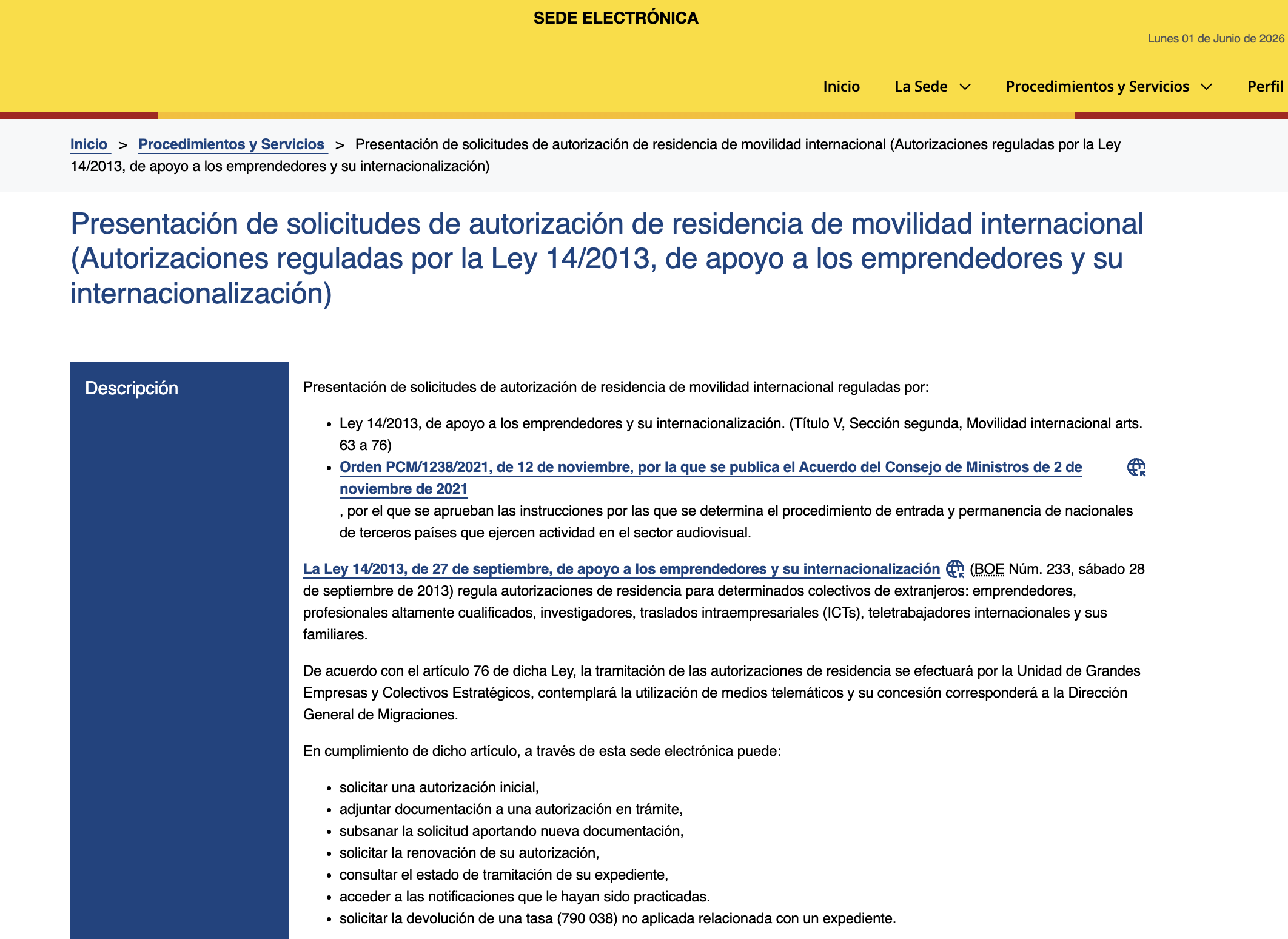
Application package. Formulario MI-T (the holder's application form, signed; family members use MI-F), full passport copy, and the Modelo 790-038 fee receipt — specifically Punto 7 for Solicitud de autorizaciones de movilidad internacional (Ley 14/2013), the DNV-specific selector, and separate from any Modelo 790-012 you paid for your NIE.
Work and income proof. A letter from your employer or main client (in Spanish, or sworn-translated to Spanish; the Abu Dhabi consulate, for example, requires sworn translation explicitly) explicitly authorising remote work from Spain, naming your role and functions, the euro salary, the authorised timeframe of the remote arrangement, and stating that the work can be done remotely. The timeframe element is required directly by Section 8.2(d) of the Instrucción Conjunta that governs the DNV. If you're relying on a bilateral social security agreement (US, UK, Canada and others), the same letter doubles as a Letter of Displacement (carta de desplazamiento): it must frame your presence in Spain as the company posting you abroad, not as a relocation you chose. That framing matters for every nationality covered by a bilateral agreement, but it bites hardest for US W-2 applicants because of the late-2025 rule shift (more on this below). Your contract, ideally without a fixed end date. The last three months of pay slips or invoices. A stamped bank certificate showing those three months of income, matching the pay slips line by line.
Company proof. An apostilled certificate from the foreign company's commercial registry showing at least one year of activity. Business owners also submit ownership proof, the last corporate tax return, evidence of business investment, and a social security report showing the company has had employees.
Qualifications. Your apostilled, sworn-translated degree certificate, or three years of relevant experience documented through a vida laboral plus per-employer letters covering dates and functions.
Compliance. A criminal record certificate (apostilled and sworn-translated) for each country lived in over the past two years, plus a signed declaration of no record over the past five. Social security: a certificate of coverage from your home country, or a commitment to register with Spain's system after approval (Régimen General for employees, RETA for autónomos). Health insurance is required only if you're not joining Spanish social security; the policy must be from a carrier authorised in Spain with no co-payments, no waiting periods, and coverage equivalent to the National Health System. Travel insurance does not qualify.
The translation rule that catches people out. Public foreign documents (criminal records, marriage and birth certificates, company registry extracts, degree certificates) must be apostilled and translated by a traductor jurado authorised by Spain's Ministry of Foreign Affairs, or done and stamped by a Spanish consulate or by your country's consulate in Spain. ChatGPT translations, freelance translators without the official authorisation, and certified translations from non-Spanish authorities are not accepted for public documents. Other documents (CV, contract, internal letters) just need a sworn translation; no apostille required. Bank statements need neither apostille nor sworn translation, a useful cost saving since they're often the bulkiest part of the file.
Employee or autónomo: how your work status shapes your tax bill
This decision quietly shapes the rest of your Spanish tax life. The DNV recognises two statuses: employee (cuenta ajena, in the Régimen General) or self-employed (cuenta propia, in RETA). The label depends on your relationship with the foreign company that signs your work letter, and the documentation has to match.
If you're a salaried employee and your country has a social-security agreement with Spain, you keep contributing to your home system. You provide a certificado de cobertura (Certificate of Coverage in the US, A1 form in the UK and EU). You're then eligible for the Beckham Law, which caps Spanish income tax at 24% on the first €600,000 of Spanish-source employment income for up to six tax years. We cover the qualifying conditions in The Beckham Law Explained: How Digital Nomads Save on Spanish Tax.
US W-2 workers have had a turbulent year. SpainGuru reported on 27 November 2025 (timestamped 8:20) that Spain had stopped accepting the US Certificate of Coverage for new DNV applications, despite having accepted it from mid-April 2025 onward. The position reversed on 8 January 2026: Spain resumed accepting it, on the condition that the employer also issues a Letter of Displacement (carta de desplazamiento) framing the employee's presence in Spain as a company posting rather than a voluntary relocation. As of mid-2026 that is still the live position. The same logic applies to any bilateral agreement route, whether UK A1, Canadian Certificate of Coverage, Colombian, Russian or others, because the foreign social security form itself never contains the word "telework." The UGE relies on the employer's displacement declaration to satisfy the cross-border telework provisions of Ley 14/2013. Spain's Ministry of Inclusion, Social Security and Migration publishes the official documentation paths.
Once you cross 183 days of physical presence in Spain in a calendar year, you become a Spanish tax resident and your worldwide income becomes reportable to the Agencia Tributaria. The 183-day line is also what makes the Beckham regime worth claiming in the first place. Most DNV holders pass it simply by living here, but it is the threshold on which the entire tax structure turns.
If you're a contractor, you register as autónomo as soon as practical after approval (it does not have to be on the same day, and autónomo applications do not require a Letter of Displacement). You then pay monthly RETA contributions plus quarterly IRPF (income tax) and IVA (VAT, though most digital nomads working for foreign clients won't charge it). Year-one contributions run around €90 per month across the board. Under the cuota cero scheme, several autonomous communities (currently Andalucía, Madrid, Galicia, the Canary Islands, and Castilla-La Mancha) reimburse those first-year contributions once you meet the conditions and apply at the end of the year. Cataluña is not on that list as of mid-2026, and regional programmes are subject to change. Year two scales with declared income and starts around €300 per month.
Autónomos are not eligible for the Beckham Law. You pay income tax on the progressive national scale: 19% on the first €12,450, up to 47% above €300,000, with regional surcharges set by your autonomous community on top. The effective rate on €100,000 taxable income lands around 36%, not 47%.
Here's the side-by-side that shapes everything else:
| Employee (cuenta ajena) | Self-employed (autónomo) | |
|---|---|---|
| Spanish social security | Régimen General | RETA |
| Beckham Law eligible | Yes | No |
| Income tax | 24% flat (Beckham) on first €600K | 19–47% progressive, plus regional surcharges |
| Social security contributions | Paid abroad via Certificate of Coverage | ~€90 first year, ~€300+ from year two |
| Income tax filings | Annual | Quarterly + annual |
| VAT filings | None | Quarterly |
| Setup speed | Slower (employer cooperation needed) | Faster (register yourself within 30 days) |
The takeaway most applicants miss: most DNV holders end up as autónomos, paying ordinary rates, not the 24% Beckham flat. The Beckham Law is real, but it's the exception, not the rule.
What changed for DNV applications in 2025 and 2026
The DNV launched in 2023. The substantive rules in Ley 14/2013 haven't changed, but the UGE-CE's interpretation has tightened twice in the past 18 months, and one piece moved twice. Three changes matter for 2026 applicants.
More documents now require apostille. Company registry certificates, corporate tax returns, and any documentation proving the foreign company is real now consistently need apostille. Two years ago many applicants got through without these. Today, missing apostilles on company documents is one of the most common rejection patterns.
Stricter scrutiny for business owners. If you own the foreign company you work for, the UGE now wants direct evidence the company is operationally real, not a shell registered to support a visa application. Expect to provide ownership proof, the last corporate tax return, evidence of investment in productive assets, client invoices, and a social security report showing the company has had employees on its books. SpainGuru's November 2025 webinar (timestamped 12:51) describes case officers actively rejecting business-owner files where the documentation looks pre-fabricated.
The US W-2 Certificate of Coverage: halt and resumption. As of January 2026, Spain has resumed accepting the US Certificate of Coverage for new DNV employee applications, following a halt in late November 2025. The condition: the employer must also issue a Letter of Displacement showing that the company is posting the employee to Spain, not that the employee is choosing the move on their own (covered above). UK A1 forms, Canadian Certificates of Coverage and other bilateral-route certificates were never blocked, but the same Letter of Displacement now sits alongside them in the standard checklist. Verify the current position with the UGE-CE or a qualified Spanish immigration lawyer before submitting as a US W-2 employee.
A new Quality Control Unit inside the UGE. In April 2026, the Director of the UGE-CE described a reorganised office with a more senior, specialised team and a new Unidad de Control that audits post-approval compliance, especially whether approved applicants actually register with Spanish social security. The unit also audits positive-administrative-silence cases. If fraud is detected in a single file handled by a particular legal representative or gestor, the UGE will review and may cancel every other application submitted by the same agent. Pick your representative carefully. (Source: Remote from Spain, April 2026.)
Renewals are treated like new applications now. If you got through in 2023 or 2024 with a thinner file, your 2026 renewal will be reviewed against current standards.
Common mistakes that get DNV applications denied
Most rejections cluster around the same handful of errors. Each has a fix. We track these in detail in Digital Nomad Visa Rejected? 7 Reasons Applications Get Denied (And How to Avoid Them).
Income documentation that doesn't match. Pay slips, bank certificate, and bank statements must show the same numbers in euros for the same three months. The UGE explicitly requires the relevant deposits to be marked separately on the bank certificate. If the totals don't reconcile to the contract, the file is denied.
Missing apostille on company documents. As of 2026 the company registry certificate must be apostilled, and the corporate tax return too if you're a business owner. If your country isn't part of the Hague Convention (most are; the UAE is one notable exception), full ministerial legalisation is required instead.
Sworn translation by the wrong person. Translations of public documents must come from a traductor jurado authorised by Spain's Ministry of Foreign Affairs, or be done and stamped by a Spanish consulate or by your country's consulate in Spain. ChatGPT translations, freelance translators without the official authorisation, and certified translations from non-Spanish authorities are not accepted for public documents.
Insufficient proof of professional experience. If you're qualifying via three years of experience rather than a degree, the file needs employment-history evidence from your country's social security or tax authority, not just your CV. Per-employer letters confirming dates and functions are also required.
A job description that does not read as 100% remote. The UGE will reject employment certificates where the job title or description implies on-site duties, physical presence, or supervision of production. The April 2026 UGE Director's conference flagged this as a fast-growing rejection reason. If your existing title or role description is ambiguous, ask your employer to issue a clarifying letter that states the role is 100% remote and references the Instrucción Conjunta's requirement for a remote-only arrangement.
Health insurance with co-payments or waiting periods. The silent killer for applicants not joining Spanish social security. Travel policies, reimbursement-only policies, anything with a copago or carencia gets the file rejected. The policy must be from a carrier authorised in Spain with coverage equivalent to the public system.
Applying from Spain too late, or underestimating document timelines. Arrive on your tourist allowance, wait until day 80 to apply, and a refusal leaves no time to reapply before having to leave Schengen. Submit within the first two or three weeks of arriving. Plan upstream too: apostilles, foreign criminal record checks, and family birth or marriage certificates each take two to three weeks at minimum, and longer if you've lived in more than one country. Order them from the country of issue well before you arrive in Spain. Most timing failures happen because someone underestimated this stage, not because of UGE delay.
Practical tips for applying from Málaga, Valencia, Barcelona, Madrid, or Alicante
The application is national, but your city affects how fast you can get surrounding appointments and whether your local infrastructure helps or slows you down.
Málaga has become the most popular DNV city for Americans and Brits. High applicant volume, strong coworking density (Málaga TechPark and the city centre cluster), and a large English-speaking community on the Costa del Sol make the soft-landing easier. The downside: TIE residency-card appointments after approval can run several weeks behind.
Alicante is worth a separate flag, and not as the easy option some readers expect. A VidaEase reviewer who applied for her TIE in Alicante city in June 2025 found city-centre appointments completely booked for weeks. She ended up taking an appointment in a different town in the province, and her family members were only able to get appointments on a third day in yet a third town. Smaller provincial offices are not automatically faster. Sometimes they are the bottleneck. Build a buffer of two to three weeks into your post-approval timeline if you're settling in Alicante province.
Valencia is widely cited as the fastest Spanish city for the NIE, which matters not because an NIE is a prerequisite for the DNV file (the UGE-CE will assign one as part of the resolution if you don't already have it) but because an NIE in advance smooths every other setup step: bank account, padrón, healthcare registration. The Calle Correus extranjería office releases appointments more reliably than Madrid or Barcelona, and the cost of living is meaningfully lower than Barcelona. For a fuller comparison across cities, see Top Cities to Apply for NIE in Spain 2026.
Barcelona has the largest expat infrastructure but the worst appointment bottlenecks for both NIE and TIE. Plan for a multi-week timeline on city-level appointments even if your DNV approval comes through quickly.
Madrid is where the UGE-CE itself sits, giving Madrid-based applicants a small advantage in chasing case status. Madrid and Barcelona also offer a workaround for the post-approval TIE appointment: you can request it in either city via the central system without an empadronamiento, sidestepping one of the main delays applicants in Valencia and Málaga run into.
The empadronamiento (city-hall registration) isn't technically required for the DNV application itself, but it is required for almost everything that comes after: bank account, healthcare registration, TIE appointment in most provinces. Plan to register at your local town hall within the first month.
DNV vs NLV: which Spanish visa do you actually need?
If you're earning active income from foreign employers or clients while in Spain, the DNV is your route. If you're funding your life from passive sources (pensions, dividends, rental income, savings drawdown) and don't intend to work, the Non-Lucrative Visa is what you want instead. The NLV has a different income threshold (400% of IPREM for the main applicant in 2026), bans active work entirely, and is the standard route for retirees moving to Costa del Sol and Costa Blanca. Apply for the wrong one and the file is denied at first review.
FAQ: Spain Digital Nomad Visa 2026
How long does the Digital Nomad Visa take to process?
UGE-CE decisions for applications from inside Spain typically come in 10 to 20 working days for a strong file. Positive administrative silence means no answer in 20 working days counts as approval. Consulate processing varies from a few weeks at fast posts to several months at slower ones.
Can I work for Spanish clients on the DNV?
Yes, but only up to 20% of your total income. Beyond that, you need a different residency category, typically a self-employed work permit.
Can I bring my family on the DNV?
Yes. Spouse, registered partner, and minor children can apply with you or join later. Unmarried partners need at least one year of cohabitation evidence (joint accounts, padrón, tenancy; the UGE expects at least two of these). Adult children up to 26 qualify if studying or actively job-seeking, financially dependent, and not in their own family unit. Parents and parents-in-law, relatives of the ascending line known as ascendientes, qualify if financially or physically dependent, with dependence presumed for ascendientes aged 80 or older.
What happens if my DNV is rejected?
Reapply once the file is corrected; in practice this is faster than appealing. If you're applying from inside Spain, time the second submission against your remaining 90-day Schengen allowance. Most rejections come from fixable gaps: a missing apostille, an income line that didn't reconcile, a translation that wasn't sworn.
Do I qualify for the Beckham Law on the DNV?
Only if you're a salaried employee approved under the employee route. Autónomos are not eligible. The Beckham application is filed within six months of registering with Spanish social security, using Modelo 149.
Is my country's Certificate of Coverage still accepted in 2026?
Variable, but better than it was. UK A1 forms, Canadian Certificates of Coverage and other bilateral-route certificates have been accepted throughout. The US Certificate of Coverage was accepted from mid-April 2025, halted in late November 2025, and back in play from 8 January 2026. In all cases, the foreign certificate is now paired with a Letter of Displacement (carta de desplazamiento) from the employer, framing your presence in Spain as a company posting rather than a personal relocation. Verify with the UGE-CE or a qualified Spanish immigration lawyer before submitting. The official documentation list is published at the Spanish Ministry of Inclusion, Social Security and Migration.
Get help with your DNV
Spain's DNV is the most accessible residency route for non-EU remote workers in Europe, but the document stack and recent rule shifts make it easy to get wrong. The VidaEase Digital Nomad Visa tool walks you through every requirement in this article with the exact documents and timelines for your situation. Start free at vidaease.co.
Moving to Spain on an NLV or Digital Nomad Visa? Stop guessing.
Most NLV and DNV applicants spend weeks piecing together their application from consulate websites, outdated blog posts, and contradictory Facebook threads, only to wonder if they've missed something.
VidaEase gives you a personalised, consulate-specific checklist for your exact situation: your visa type, your consulate, your family setup. Every document you need, in the right order, with the common mistakes that get applications rejected already flagged for you. Auto-filled forms included.
We're launching soon with NLV coverage for the London, New York, and Miami consulates, plus the DNV in-Spain (UGE) pathway. Founding Member spots are limited to 100. Sign up at vidaease.co to be first through the door, and to lock in founding pricing before it closes.