Non-Lucrative Visa Spain 2026: The Complete Guide for Retirees and Non-Workers
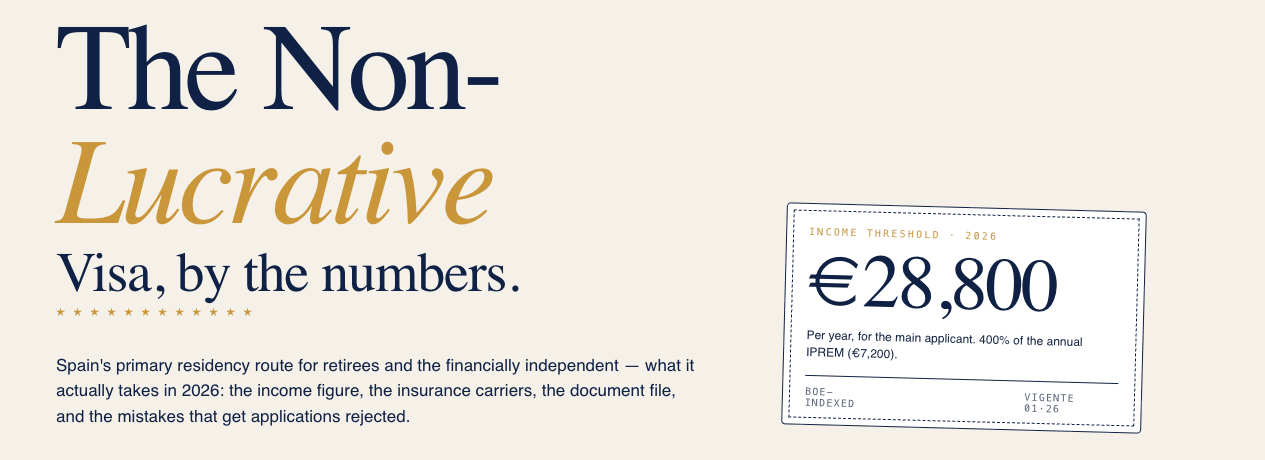
The Non-Lucrative Visa is Spain’s main route for retirees and the financially independent. Here is what it actually takes in 2026: the income figure, the insurance rules, the document file, and the mistakes that get applications rejected.

Spain’s “non-lucrative visa” (more formally, the non-lucrative residence visa) remains one of the simplest and most attractive ways for non-EU citizens to live in Spain in 2026—without needing to work locally. In short: if you can prove sufficient passive income or savings, secure private health insurance, and stay outside the Spanish labor market, you can gain legal residency in one of Europe’s most desirable countries. It’s especially popular with retirees, remote-income earners, and financially independent expats who want lifestyle first, bureaucracy second. But while the concept is straightforward, the application process is detail-heavy—and small mistakes can lead to costly delays or rejections.
What the Non-Lucrative Visa is, and who it actually fits
The non-lucrative visa Spain offers (NLV for short) is a residence visa for non-EU citizens who can support themselves without working in Spain. The Spanish state grants you the right to live in the country for one year, renewable, on the condition that your money comes from outside Spain and that you do not take a Spanish job, freelance for Spanish clients, or run a business registered in Spain. The “non-lucrative” label is literal: you can earn income, but not from Spanish sources.
This makes the NLV the default route for retirees on a state pension or private drawdown, for early-retired professionals living off investments, and for property owners with rental income from outside Spain. It is also the route many financially independent people take when they want a base in the EU but do not need to work.
It is not the right fit for remote workers who plan to keep their job. That is the Digital Nomad Visa, and we cover the difference further down. If you are unsure which one applies to you, the income rules and the work rules tell you almost immediately: the NLV bans paid work in Spain, the DNV requires it from a non-Spanish employer.
For the full side-by-side, including the income test, tax treatment, and which one your situation actually qualifies for, read Spain DNV vs Non-Lucrative Visa: Which Is Right for You?.
The 2026 income requirement: IPREM math and what counts as “passive”
The income test for the NLV is set as a multiple of IPREM, the Indicador Público de Renta de Efectos Múltiples. IPREM is the reference figure Spain uses for almost all means-tested rules, and it is updated each January through the General State Budget Law and published in the BOE.
The rule itself is fixed and does not move year on year. The main applicant must show 400 percent of the annual IPREM. Each dependent (a spouse or a child) adds another 100 percent on top.
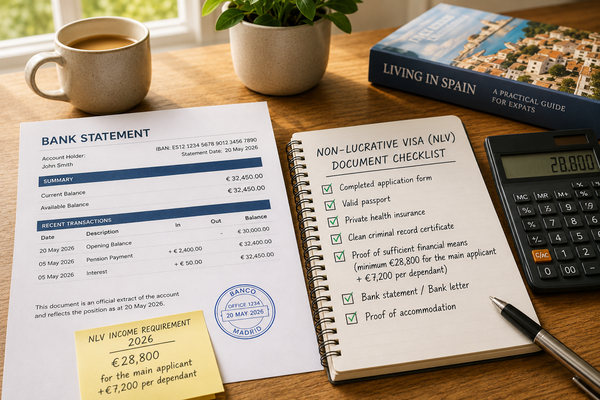
At the time of writing in 2026, the IPREM stands at €600 per month, or €7,200 per year. That puts the figures at:
- Main applicant: €28,800 per year (or roughly €2,400 per month)
- Each dependent: €7,200 per year (or €600 per month)
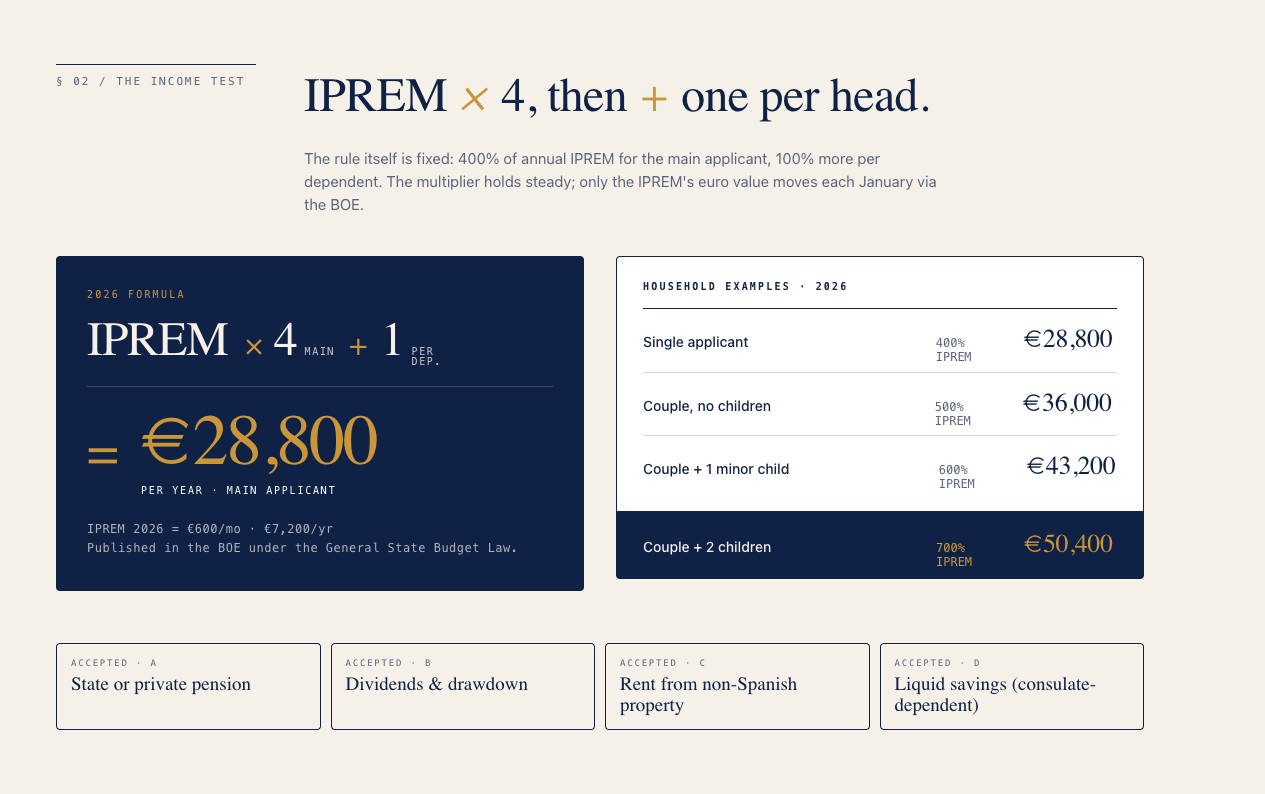
A couple with no children needs to show €36,000 per year. A couple with one minor child needs to show €43,200 per year. Always verify the current IPREM against the BOE before you apply, because the multiplier holds steady but the euro value moves whenever the government updates the index.
What actually counts as proof? Pension statements, dividend records, rental income from property outside Spain, drawdown from an investment account, or simply enough liquid savings to cover the threshold for the year. Most consulates want twelve months of bank statements showing a steady balance and a stable inflow, plus a letter from your bank confirming the account in your name. Savings alone work for some consulates and not for others. The London consulate, for example, has historically accepted a savings-only application; some US consulates will push back unless they see a regular income flow as well.
Private health insurance that passes consulate scrutiny in 2026
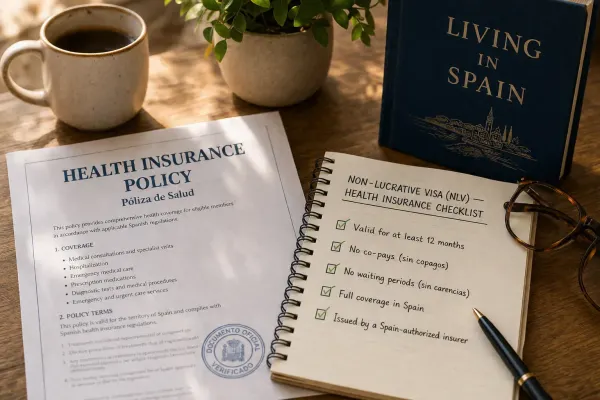
Spanish consulates apply a strict definition of acceptable health insurance for the NLV. The policy must be from a carrier licensed to operate in Spain, must offer cover equivalent to the Spanish public health system, must cover the entire Spanish national territory, and must come with no co-payments, no waiting periods, no coverage caps, and a minimum twelve-month policy term running from the date you enter Spain. The certificate the carrier issues for the visa application should explicitly state “sin copagos” (no co-payments) and “sin franquicia” (no excess). Travel insurance does not qualify, no matter how generous the policy looks.
In practice that means Sanitas, Adeslas, DKV, Mapfre, Asisa, or Caser. These are the carriers most consulates recognize on sight, and they all sell NLV-specific policies with the right cover and a “para visado” or “convalidable” certificate that you submit with the application. You pay the full year up front. Premiums in 2026 sit roughly at €45–€85 per month for applicants under 65 and €80–€150 per month for applicants over 65, with the spread driven by age and any pre-existing conditions.
The most common rejection on insurance is buying a generic international expat policy that has co-payments or a deductible. The consulate will refuse it, and you will need to buy a second policy and resubmit. Avoid the global plans you may have used while traveling and start with a Spanish carrier from the outset.
Documents, apostilles, and translations: building your application file
The NLV file is heavy on certified paperwork. Every document issued outside Spain must be apostilled in the country of issue under the Hague Convention, and every non-Spanish document must then be translated by a sworn translator (traductor jurado) registered with Spain’s Ministry of Foreign Affairs. The order matters: apostille first, then sworn translation, then submit the bundled set.
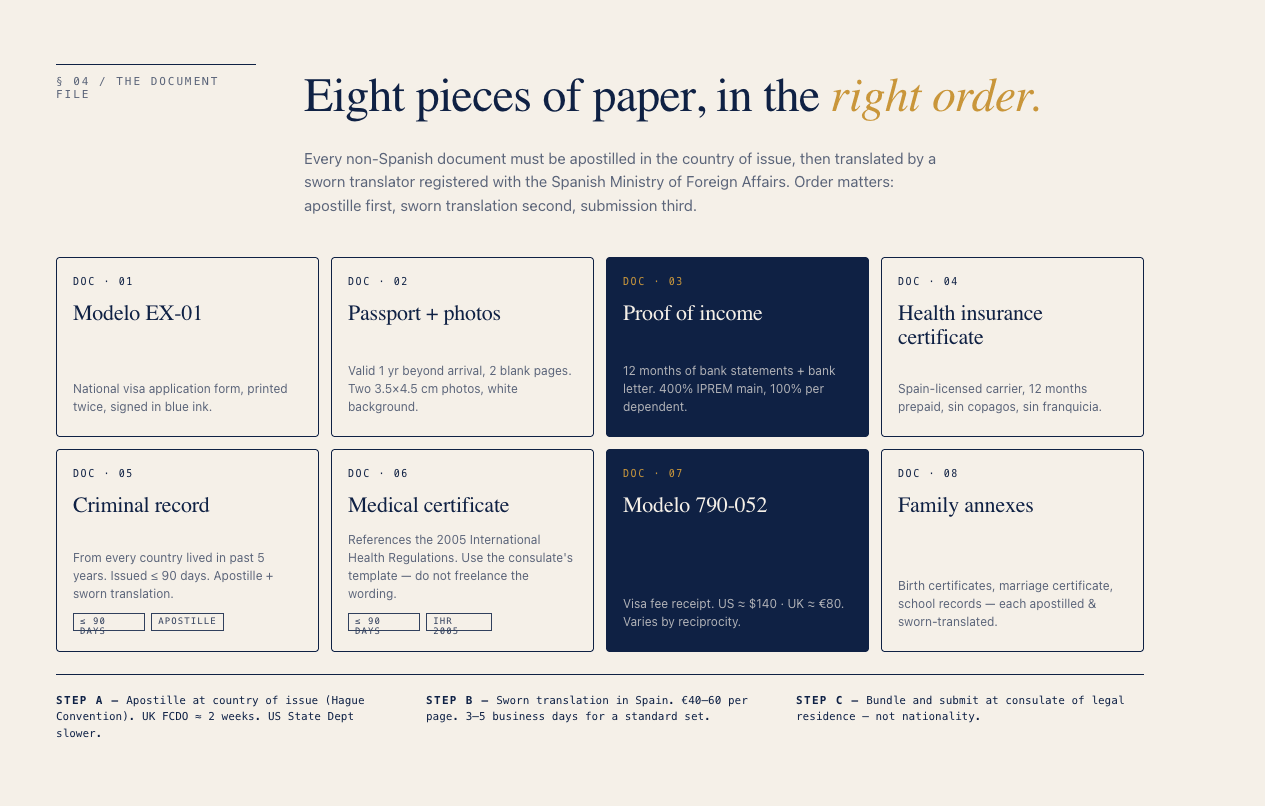
The standard application file includes:
- The completed national visa application form (Modelo EX-01), printed twice and signed in blue ink.
- A passport valid for at least one year past your planned arrival date, with two blank pages.
- Two recent passport-format photographs (3.5 × 4.5 cm, white background).
- Proof of income or savings covering 400 percent of IPREM for the main applicant, plus 100 percent per dependent.
- Private health insurance certificate from a Spain-licensed carrier, paid for twelve months, with no co-payments and no waiting periods.
- A criminal record certificate from every country you have lived in for the past five years, issued within the last 90 days, apostilled and sworn-translated.
- A medical certificate (certificado médico) issued within the last 90 days, stating that you do not suffer from any disease that could cause serious public health repercussions under the 2005 International Health Regulations. Specific wording matters; many consulates provide a downloadable template on their website, and you should use it rather than ask your doctor to draft the letter from scratch.
- Proof of payment of the Modelo 790-052 visa fee. The fee varies by nationality (US applicants currently pay around $140; UK applicants pay roughly €80) and is set by reciprocity rules.
Apostille turnaround is the slowest step in the file. The UK FCDO Legalisation Office takes around two weeks for the standard service. The US Department of State takes longer, and many applicants use a third-party legalisation service to compress the timeline. Sworn translation in Spain costs around €40–€60 per page and takes three to five business days for a standard set.
The application process step-by-step: from consulate appointment to TIE
You apply for the NLV at the Spanish consulate that covers your legal residence, not the consulate of your nationality. A US citizen living in California applies through the Los Angeles consulate. A UK citizen living in Edinburgh applies through Edinburgh. A British citizen who has been resident in Dubai for a year applies through Abu Dhabi. The rule is consistent across the network.
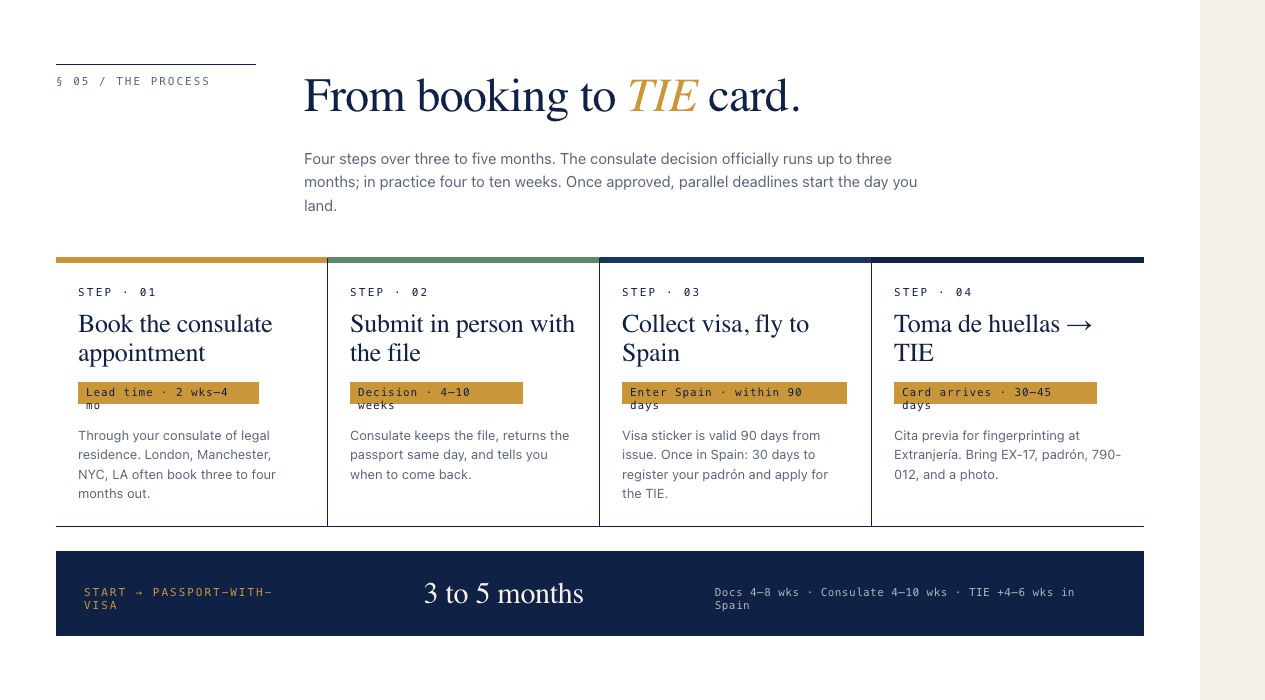
Step 1: Book the consulate appointment
Appointments are released through each consulate’s online booking system, and availability varies wildly by location. London, Manchester, New York, and Los Angeles often book three to four months out. Smaller consulates can have slots within two weeks. Book the appointment first, then build your document file around the date.
Step 2: Submit the application in person
You attend the consulate in person on the appointment date with the full file, the original passport, and the visa fee. The consulate keeps the file, returns the passport at the appointment, and tells you when to come back to collect the visa sticker. The decision window is officially up to three months and in practice runs four to ten weeks depending on the consulate.
Step 3: Collect the visa and travel to Spain
When the visa is approved, you return to the consulate to collect your passport with the visa sticker. The visa is valid for 90 days from issue, and you must enter Spain within that window. Arrive earlier than later. Once you are in Spain, a parallel deadline starts: you have one month to register your address (empadronamiento) and 30 days from arrival to apply for your TIE (Tarjeta de Identidad de Extranjero), the physical residency card.
Step 4: Apply for the TIE in Spain
Book a cita previa for “Toma de huellas” (fingerprinting) at your local Oficina de Extranjería or designated police station. Bring the EX-17 form, your passport, your empadronamiento certificate, the Modelo 790-012 fee receipt, and a passport photo. The TIE card arrives 30 to 45 days after fingerprinting and is collected in person.
Common mistakes that get NLV applications rejected
The NLV is not difficult to qualify for, but it is easy to fail on procedure. The most common reasons applications come back rejected:
Insurance with co-payments or a deductible. International expat policies often look comprehensive but include a 20 percent co-pay or a €100 excess. Spanish consulates treat this as disqualifying. Buy a Spanish carrier policy marked “sin copagos” and “sin franquicia”, with cover for the entire Spanish national territory, from the start.
Income that fluctuates month to month. Investment drawdown that varies, freelance income with no clearly stated Spanish ban, or recent large deposits without explanation will trigger a request for clarification or a refusal. Smooth, predictable, documented income passes faster than a strong but uneven number.
Stale documents. The criminal record certificate and the medical certificate must be issued within 90 days of submission. Apostilles do not expire, but the underlying document does. Time the apostille run to land inside the 90-day window so you do not pay twice.
Wrong consulate. Applying through the consulate of your nationality rather than your legal residence will get the file returned. Confirm jurisdiction on the consulate website before you book the appointment.
Missing the medical-certificate wording. A generic doctor’s letter saying you are healthy will be rejected. The certificate must reference the 2005 International Health Regulations and state that you do not suffer from any disease causing serious public health repercussions. Most consulates publish a template; using it is the safest way to get the wording right.
Trying to work in Spain after arrival. Even a single Spanish freelance invoice will breach the visa terms and complicate your renewal. Spanish-source income is the bright line; remote income from abroad is the grey area discussed in the FAQ.
Practical tips for choosing where to land
Most NLV holders cluster on the Costa del Sol, the Costa Blanca, and the Balearics. Each has its trade-offs.
The Costa del Sol (Málaga province) is the densest English-speaking expat region in Spain. Estepona, Marbella, Fuengirola, and Mijas all have established Anglophone communities, English-speaking GPs, and gestorías that handle NLV renewals routinely. Málaga city itself has the third-busiest airport in Spain, which matters for grandchildren visits. Property is the most expensive in the region; a two-bedroom flat in central Marbella runs €1,500–€2,200 a month long-term in 2026.
The Costa Blanca (Alicante province) is the older choice. Jávea, Dénia, and Altea draw a heavy UK and Northern European retiree population, and prices sit lower than the Costa del Sol. A two-bedroom flat in Dénia runs €900–€1,300 a month long-term. Alicante airport is well-connected to the UK, Ireland, and Northern European cities. Healthcare is good, though the gap between summer and winter populations is sharper.
The Balearics (Mallorca, Menorca, Ibiza) offer a similar lifestyle in island form, with the seasonal access trade-off. Palma de Mallorca is the practical choice if you want city amenities; the Tramuntana villages are quieter and more expensive. Insurance and gestoría costs are comparable to the mainland; flights add up over a year if family visits are frequent.
Pick on healthcare access and airport links first, weather and view second. The view does not change. The gestoría you can reach in twenty minutes does.
NLV vs DNV: which visa fits your situation
The choice usually comes down to whether you intend to keep working.
The NLV requires you to stay out of the Spanish labour market and prove enough passive income or savings to support yourself. It is the right route for retirees, the financially independent, and people whose income is fully passive (pension, dividends, rental income from outside Spain, drawdown from investments).
The Digital Nomad Visa was introduced under Spain’s 2023 startups law and is built for remote workers who keep a job or freelance contract with non-Spanish clients. It allows you to work, has a lower income threshold (200 percent of the Spanish minimum wage rather than 400 percent of IPREM), grants tax advantages under the Beckham regime if you opt in, and is processed faster. The trade-off is that you must show an active employment or freelance contract, not just income.
If you can choose either, the DNV is usually the better deal for anyone under retirement age. The NLV is the right route when there is no live employment relationship to point to, and when the goal is residency for lifestyle rather than for work. For the side-by-side breakdown, see DNV vs NLV: which Spanish visa fits you.
FAQ: Non-Lucrative Visa Spain
Can I work remotely for a non-Spanish employer on the NLV?
This is the grey area of the visa. The visa terms say you may not undertake “lucrative activity” in Spain, and Spanish authorities have historically interpreted this as covering remote work even for foreign employers. A handful of consulates have softened that view in recent years, but the safer reading is still that the NLV is for non-workers. If you plan to keep working remotely, the DNV is built for you.
How long does the NLV process take from start to finish?
Document preparation runs four to eight weeks (the apostille and translation steps are the slowest). The consulate decision then takes four to ten weeks. Total time from starting to passport-with-visa is typically three to five months. Add another four to six weeks once you arrive in Spain to complete the empadronamiento, fingerprinting, and TIE collection.
Can I bring my spouse and children?
Yes. The NLV supports family reunification at the time of application, provided you can show 100 percent of IPREM (€7,200 per year in 2026) for each dependent on top of your own 400 percent. A married couple with two children needs to show €50,400 per year. Children’s documents (birth certificates, school records) need their own apostille and sworn translation.
Do I need to speak Spanish?
Not for the visa itself. You will need it to navigate empadronamiento, healthcare, and most local interactions, and the renewal process is easier when you can read the official letters. Most NLV holders manage with a gestor for the first year and learn the language as they settle.
How does the NLV affect my taxes?
If you spend more than 183 days in Spain in a calendar year you become a Spanish tax resident, with worldwide income reportable in Spain. This is the single biggest financial decision around the NLV, and it is worth a one-hour conversation with a Spanish tax advisor before you apply. The NLV does not give you any tax shelter; the DNV’s Beckham regime does.
Can I travel inside the Schengen Area on the NLV?
Yes. Once you hold a Spanish residency card (TIE), you can travel freely across the Schengen Area for short stays under the standard 90/180 rule, the same as any Spanish resident. You cannot work in another Schengen country on the Spanish visa.
This is a general guide based on 2026 practices. Requirements can vary by consulate and by individual case. Always verify the current rules with the official Spanish consulate that covers your legal residence, and consider professional advice from a gestoría, immigration lawyer, or tax advisor for your specific situation.
Spain’s bureaucracy is the part of moving here that costs the most time and money, and it is where VidaEase saves both. VidaEase is the interactive checklist and timeline tool that takes you through the full journey: from your first NLV documents and consulate appointment, through your TIE in Spain, your annual renewal, and the long-term residency compliance that follows. The forms and deadlines stay current in the app as the rules change. Start free at vidaease.co.
Moving to Spain on an NLV or Digital Nomad Visa? Stop guessing.
Moving to Spain on an NLV or Digital Nomad Visa? Stop guessing. Most NLV and DNV applicants spend weeks piecing together their application from consulate websites, outdated blog posts, and contradictory Facebook threads, only to wonder if they've missed something.
VidaEase gives you a personalized, consulate-specific checklist for your exact situation: your visa type, your consulate, your family setup. Every document you need, in the right order, with the common mistakes that get applications rejected already flagged for you. Auto-filled forms included.
We're launching soon with NLV coverage for the London, New York, and Miami consulates, plus the DNV in-Spain (UGE) pathway. Founding Member spots are limited to 100. Sign up at vidaease.co to be first through the door, and to lock in founding pricing before it closes.