Spain Digital Nomad Visa vs Non-Lucrative Visa: Which Is Right for you?

Last updated: 24 April 2026 — income figures refreshed for the 2026 SMI increase (Real Decreto 39/2026) and new NLV work-cessation requirements
If you're planning a move to Spain and you've been doing your research, you've
almost certainly landed on the same two options: the Spain Digital Nomad Visa vs Non-Lucrative Visa debate. These are the two most common legal pathways for English-speaking expats who want to live in Spain long-term but they work very differently and suit very different profiles. Making the wrong choice costs you months of preparation, an expired apostilled background check, and a second application filed under worse conditions than the first.
This article breaks down exactly what each visa is, who qualifies, what it costs,
and how to decide which one fits your actual life — not just the life you think
you're going to have.
What Is the Spain Digital Nomad Visa?
Spain's Digital Nomad Visa (DNV) was introduced in 2023 as part of the country's Startup Act (Law 28/2022, Ley de Startups), with implementing rules in Royal Decree 1155/2024. It was designed to attract remote workers and freelancers who earn their income from clients or employers outside Spain, or at least primarily outside Spain.
The key word here is active. The DNV is for people who are working. You need a
job, clients, or a business that generates income, and that income needs to be
verifiable and consistent.
Key features of the DNV:
- Initial duration of 1 year (if applied for as a visa at a Spanish consulate abroad) or 3 years (if applied for as a residence permit from within Spain, via the UGE-CE route)
- Renewable for 2-year periods after that
- Allows you to work remotely for foreign companies or clients
- Permits up to 20% of your total income to come from Spanish clients
(anything more and you need a different permit) - Family members can be included as dependants on the same application
- Gives access to Spain's special expat tax regime (more on that below)
- Path to permanent residency after 5 continuous years
Income requirements:
You need to demonstrate a gross monthly income of at least 200% of Spain's minimum wage (the SMI). Spain raised the SMI on 18 February 2026 under Real Decreto 39/2026, which sets the 2026 figure at €1,221 per month across 14 payments. That takes the DNV income threshold to €2,849 per month, or €34,188 per year, for a solo applicant.
For each dependent, add 75% of the SMI for a spouse or registered partner (€1,069 per month) and 25% for each additional child or dependent (€357 per month). A family of four (two adults plus two children) needs to show roughly €4,632 per month to clear the threshold.
A practical note on currency. If your income is paid in dollars or pounds, consulates convert at the European Central Bank rate on the day of application. Hold a buffer of at least 10-15% above the minimum to protect against exchange-rate swings between your application date and your consulate appointment.
You'll also need to have been working for your current employer or clients for at
least 3 months before applying, and your employer must confirm that remote work
is permitted.
What Is the Non-Lucrative Visa?
The Non-Lucrative Visa (NLV) has been around for decades (regulated under Organic Law 4/2000 and Article 47 of Royal Decree 557/2011) and is the go-to route for people who want to live in Spain without working: retirees living off a pension, people with substantial savings or investment income, or anyone whose income is entirely passive.
The name says it all: non-lucrative means you are explicitly not allowed to
engage in any professional or commercial activity in Spain. That includes remote
work. If you're freelancing from your terrace in Málaga on an NLV, you're in
breach of your visa conditions.
Key features of the NLV:
- Initial duration of 1 year, renewable for 2-year periods
- No right to work — passive income only
- You (and your family, if included) must have comprehensive private health
insurance with a Spanish provider - Must spend more than 183 days per year in Spain (making you tax resident)
- Path to permanent residency after 5 continuous years
Income requirements:
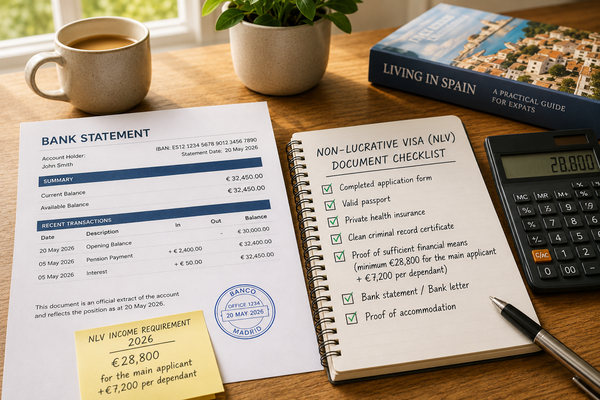
The NLV requires proof of income based on a multiple of Spain's IPREM (the Indicador Público de Renta de Efectos Múltiples, a public income reference index). The requirement is 400% of the annual IPREM for the main applicant, which for 2026 means €28,800 per year, or €2,400 per month. For each dependant, add 100% of IPREM: €7,200 per year, or €600 per month. A couple applying together therefore needs €36,000 per year.
The IPREM has been frozen at €600 per month since 2023 because Spain's General State Budget has not been formally renewed; the 2023 figures carry over into 2026 by default. Check the BOE before you apply in case a new budget law adjusts the figure mid-year.
Unlike the DNV, NLV income can come from savings, a pension, rental income, dividends, or other passive sources. Many applicants demonstrate this via a combination of bank statements and proof of ongoing income streams.
The 2026 work-cessation requirement. This is new and catches applicants off-guard. Spanish consulates (including Los Angeles, Washington DC, and Houston) now explicitly require applicants of working age to prove they are no longer working before the NLV is granted. Depending on your situation, you will need to provide one of:
- A formal termination letter from your employer, confirming you no longer work for the company
- An official retirement certificate or pension letter, if you are retiring
- A notarized affidavit, signed before a notary public, explicitly committing that you will not work, telework, or actively manage a business while residing in Spain
Simply showing savings is no longer enough. Consulates are filtering out applicants who are really remote workers trying to use the NLV as a shortcut. If you plan to continue working in any form, the NLV is closed to you, and the DNV is your visa instead.
The 2026 Comparison Table
Here are the two visas side by side on the 2026 figures.
| Factor | Digital Nomad Visa (DNV) | Non-Lucrative Visa (NLV) |
|---|---|---|
| Legal basis | Law 28/2022; Royal Decree 1155/2024 | Organic Law 4/2000; Royal Decree 557/2011, Art. 47 |
| Income benchmark | 200% of SMI | 400% of IPREM |
| 2026 solo applicant threshold | €2,849/month (€34,188/year) | €2,400/month (€28,800/year) |
| Spouse/partner add-on | +€1,069/month | +€600/month |
| Each additional dependant | +€357/month | +€600/month |
| Income source | Primarily non-Spanish (80%+) | Passive only; no work of any kind |
| Can you work? | Yes, remotely for non-Spanish companies | No |
| Savings alternative | Some consulates accept €34,188+ | Yes: €28,800 Year 1, €57,600 for 2-year renewal |
| Initial validity | 1 year (consulate) or 3 years (from inside Spain) | 1 year |
| Renewal | 2 years, then 2 more | 2 years, then 2 more |
| Long-term residence | After 5 years | After 5 years |
| Tax regime | Beckham Law eligible (flat 24% up to €600k for 6 years) | Standard Spanish progressive rates on worldwide income |
| Consular fee | ~€80 | ~€80 (plus reciprocity fee for some nationalities) |
| Processing time | ~20 working days + 1 month for TIE | 2–12 weeks depending on consulate |
| 2026 procedural change | UGE-CE route now accepts W2 applicants with stricter income-origin proof | Formal work-cessation proof now mandatory |
Sources: Law 28/2022 (BOE-A-2022-21739); Real Decreto 39/2026; Royal Decree 557/2011; consular instructions from the Spanish consulates (exteriores.gob.es).
Use the calculator below to check whether your income and situation qualify — it takes about 60 seconds.
If the answer for you is the NLV, the next step is the full application walkthrough. Read Non-Lucrative Visa Spain 2026: The Complete Guide for Retirees and Non-Workers for the income test, the insurance rules, the document file, and the consulate process step by step.
Spain DNV vs Non-Lucrative Visa: The Core Differences
This is where it gets practical. Let's put the two side by side on the things
that actually matter.
1. Can You Work?
This is the fundamental split. On the DNV, working remotely for foreign clients
is the whole point. On the NLV, it's prohibited. If you have any active income —
freelance projects, a salaried remote job, consulting — you need the DNV.
There's no grey area here.
A common misconception is that "passive income" covers things like selling
digital products or running an online store. It generally doesn't. If you're
actively running a business, even remotely, the NLV is not your visa.
2. Type of Income Required
The DNV looks for consistent, verifiable, active employment or business income.
Payslips, contracts, invoices — it needs to be clear that you're working and
getting paid.
The NLV looks for passive or investment income: pensions, rental yields,
dividends, interest, or demonstrable savings large enough to sustain you.
If your income comes from a portfolio or a pension rather than a paycheck,
the NLV is the more natural fit.
3. Tax Treatment
This is where the DNV has a significant advantage for high earners.
DNV holders can apply for Spain's special expat tax regime, commonly known as the Beckham Law (Régimen Especial de Trabajadores Desplazados, regulated under Article 93 of Spain's Personal Income Tax Law). Under this regime, you pay a flat 24% income tax rate on Spanish-sourced income up to €600,000, rather than the standard progressive rates that can climb to 47% in most autonomous communities.
There are three things to know before you rely on it. First, to qualify you must not have been a Spanish tax resident in the five years before your application. Second, you have to actively elect the regime within six months of registering with Spanish Social Security, or the window closes. Third, the regime runs for six tax years total (the year of arrival plus five), after which you return to standard Spanish tax rates.
For a remote worker earning €100,000+, the Beckham election can save tens of thousands of euros per year compared to standard progressive rates. If you're on the edge of deciding between DNV and NLV and your income is well into six figures, the tax saving alone can be the decider.
NLV holders become standard Spanish tax residents from day one and are taxed on their worldwide income at progressive rates. If you're living off savings or
a modest pension, this may not make a significant difference. If you're a
high-income remote worker, it absolutely does.
4. Application Process and Where You Apply
Both visas are applied for at the Spanish consulate in your home country
(or the country where you have legal residency). The documentation is
substantial for both — apostilled certificates, background checks, medical
certificates, proof of income, insurance, the works.
The DNV is a newer visa with less standardized consulate-level processing.
Some consulates are more experienced with it than others, and processing
times can be unpredictable. The NLV is a mature visa category — consulates
know it well, which generally means more predictable timelines.
Both typically take 1–3 months to process, though this varies by consulate
and your individual circumstances.
5. Renewal and Long-Term Path
Both visas follow a similar long-term path: initial period, renewals, then
permanent residency eligibility after 5 continuous years, followed by the
option to apply for Spanish nationality after 10 years.
One important note: NLV renewals require you to continue demonstrating that
you are not working and that you still meet the passive income threshold.
If your situation changes — say, you pick up freelance work — you'll need to
switch visa categories.
Spain DNV vs Non-Lucrative Visa: Who Should Choose Which?
Let's make this even more direct.
Choose the Digital Nomad Visa if:
- You work remotely for a foreign employer or have foreign clients
- You're a freelancer, contractor, or entrepreneur with verifiable income
- You're in the 28–45 age range and your income is work-derived
- You want to take advantage of the Beckham Law tax regime
- Your income comfortably exceeds €2,849/month (the 2026 DNV threshold)
Choose the Non-Lucrative Visa if:
- You're retired and living off a pension or savings
- Your income is entirely passive (investments, rental income, dividends)
- You have no intention of working in any capacity while in Spain
- You can demonstrate at least €28,800 per year in passive income
- You want a well-trodden, relatively predictable application process
The grey area — hybrid income situations:
If you're partially retired but still doing some consulting work, or if you're
drawing down savings while also doing occasional freelance projects, neither
visa fits cleanly. In this case you almost certainly need the DNV, even if
your active income is modest, because the NLV's prohibition on work is absolute.
A Spanish immigration lawyer — not just an online forum — is worth the
consultation fee here.
FAQ: DNV vs Non-Lucrative Visa
Can I switch from the NLV to the DNV later?
Yes, visa-status changes are possible at renewal points, but they restart parts of the bureaucratic process and require meeting the new visa's full requirements. Most applicants who anticipate needing to work within their first few years in Spain should start on the DNV rather than planning to switch.
Can I apply for the DNV from inside Spain?
Yes. You can enter Spain on a standard Schengen tourist stay (90 days) and apply for a 3-year DNV residence authorization from within Spain through the UGE-CE (Unidad de Grandes Empresas) route. The consulate route grants a 1-year visa instead. The in-Spain route is generally faster and gives a longer initial grant, but your immigration status during the application window needs careful handling.
Does US W2 employment qualify for the DNV?
As of 2026, yes. Spanish immigration authorities have approved W2 applicants whose US employer confirms in writing that remote work from Spain is authorized. The Social Security totalization question (the US does not have a totalization agreement that covers DNV-style remote work) remains a complication that an immigration lawyer can structure around.
What happens if I'm caught working on an NLV?
Your residence authorization will not be renewed and you may face tax-residency investigation by the Agencia Tributaria. The 2026 work-cessation affidavit and termination-letter requirements exist specifically to filter out remote workers applying for the NLV as a shortcut. If you intend to work in any capacity, the DNV is the correct visa.
Do I need a gestor or immigration lawyer to apply?
Not strictly required, but you need to do your research to confirm that your chosen visa matches your situation before you start paperwork. Full-service gestoría packages run €1,500–€3,500 depending on complexity. VidaEase is launching soon with a tailored, interactive checklist based on your specific situation — nationality, income source, and the consulate covering your location. Sign up at vidaease.co to get early access.
Can savings alone qualify me for either visa?
For the NLV, yes. Most consulates accept liquid savings equivalent to €28,800 for the first year and €57,600 for the 2-year renewal, demonstrated through bank statements. For the DNV, savings-only applications are accepted by some consulates but not all, and the stronger file combines savings with active income from non-Spanish clients or employers.
Common Mistakes to Avoid
Applying for the wrong visa and pivoting later. Switching visa categories
mid-process or after approval is possible but bureaucratically painful.
Get the right one first.
Underestimating the documentation requirements. Both visas require
apostilled documents, and if you're in the UK or US, getting apostilles
sorted takes time. Start 3–4 months before your intended move date.
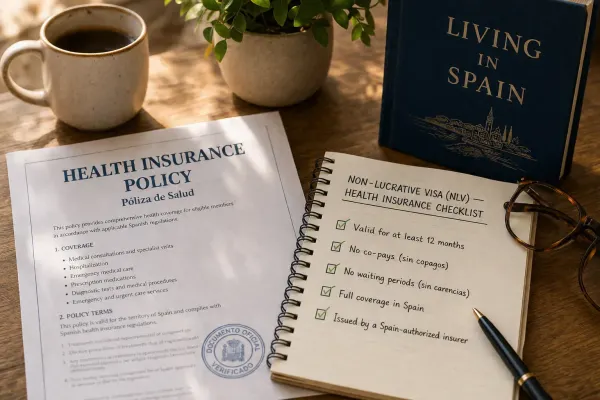
Assuming your health insurance from home will qualify. Both visas require comprehensive Spanish private health insurance with no copayments and no expiry date tied to the visa period. Most travel insurance policies don't
qualify. Get a quote from a Spanish insurer (Sanitas, AXA, Asisa, and
Allianz are common choices among expats) before you start your application.
Forgetting about the NIE. Your NIE (Número de Identificación de Extranjero)
is your Spanish tax and identification number, and you'll need it for almost
everything — opening a bank account, signing a rental contract, registering
with a GP. It's normally separate from your visa application when applying from a consulate abroad. See this guide for details on how and where to apply for a NIE.
Not registering on the padrón. Once you're in Spain, you need to register
at your local town hall (ayuntamiento) on the padrón municipal. This is your
official record of residence and unlocks access to local services including
the public healthcare system.
The Honest Bottom Line
Neither visa is easier than the other — they're just designed for different
people. If you're a remote worker with consistent foreign income, the DNV is
your route, and the Beckham Law tax advantage makes it genuinely attractive.
If you're retiring to Spain and living off passive income or a pension, the
NLV is the cleaner, more established path.
What both visas share is a paperwork burden that surprises most applicants.
Build in time, budget for a local gestor or immigration lawyer to handle the
Spanish bureaucracy end, and don't assume anything is as straightforward as
it sounds on an expat Facebook group.
Spain is worth it. Just go in with your eyes open.
Moving to Spain on an NLV or Digital Nomad Visa? Stop guessing.
Moving to Spain on an NLV or Digital Nomad Visa? Stop guessing. Most NLV and DNV applicants spend weeks piecing together their application from consulate websites, outdated blog posts, and contradictory Facebook threads, only to wonder if they've missed something.
VidaEase gives you a personalized, consulate-specific checklist for your exact situation: your visa type, your consulate, your family setup. Every document you need, in the right order, with the common mistakes that get applications rejected already flagged for you. Auto-filled forms included.
We're launching soon with NLV coverage for the London, New York, and Miami consulates, plus the DNV in-Spain (UGE) pathway. Founding Member spots are limited to 100. Sign up at vidaease.co to be first through the door, and to lock in founding pricing before it closes.